
I’ve reported on different aspects of the war in Ukraine since I joined the New York Times. I have done hundreds of maps and gathered my thoughts with documents, interviews from experts, and chats with my colleagues about many aspects of what’s been going on in Ukraine for years.
You would be surprised about the many pieces projects leave behind in the sake of editing. But sometimes those “unseen” elements can come back, maybe even as a whole new story, and that’s exactly what happened recently with this piece we published titled “Tanks Were Just Tanks, Until Drones Made Them Change”. Take a look there if you haven’t seen it already, then come back here if you want learn more on how that piece was born.
The New War in Ukraine (Feb. 2025)
Back in February, I was working on a piece to show how the battlefields in Ukraine were changing due to the intense use of small drones. The introduction of those little unmanned attack units changed completely how the front lines look.
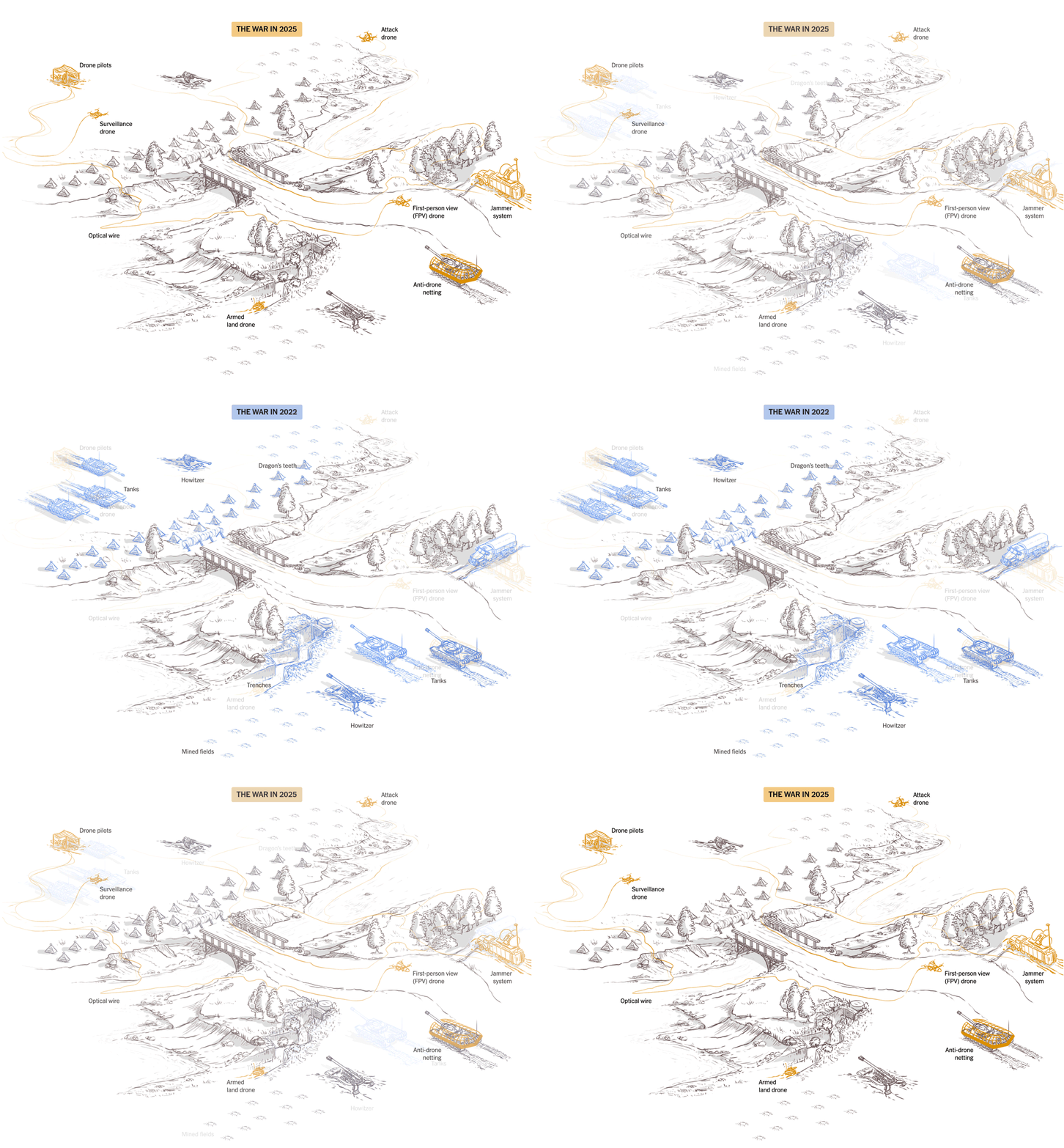
It’s true that drones have been around for a long time; they are not a “last-year” innovation, but they have never before been used as intensively as in Ukraine. The war now is fought mostly with First Person View (FPV) drones and many other unmanned vehicles.
That piece from February touches slightly on how tanks started to appear with improvised structures on top. Known as “turtle tanks”, they look nothing like a regular tank; soldiers added structures on top as a way to reduce damage from drone attacks.
We used photos on that story to illustrate the turtle tanks.
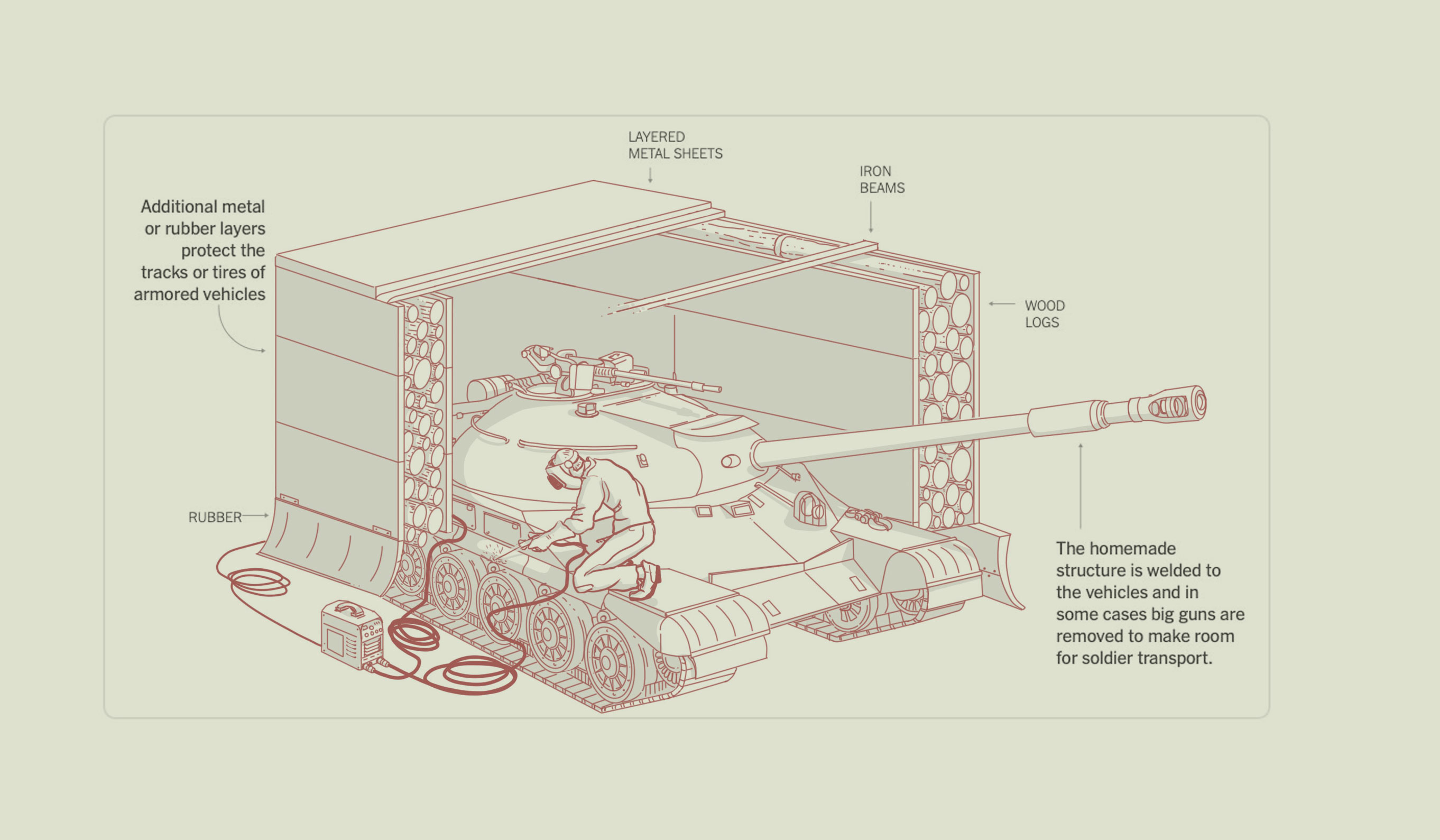
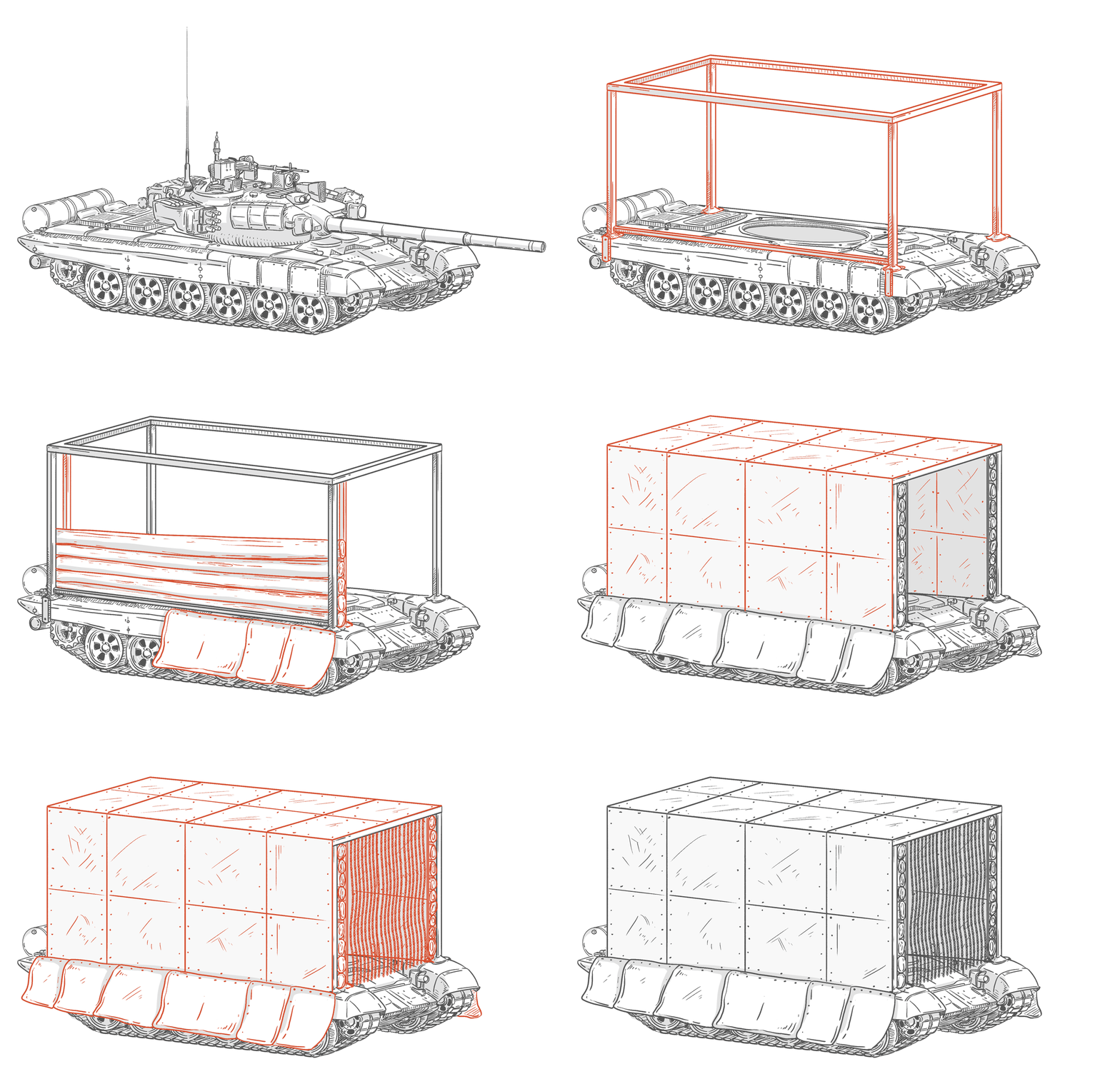
Among the many materials we got access to, I saw videos of a Russian workshop showing how tanks were being repurposed to become transport vehicles. The inside was just a box with layers and layers of protection, including even tree logs to shield from the drone bombs. Really fascinating aspect on how vehicles were dealing with the increase in drone attacks. I did a quick doodle to describe that, but since the piece’s focus was a little different, I actually cut it off since the photo was serving the same purpose.
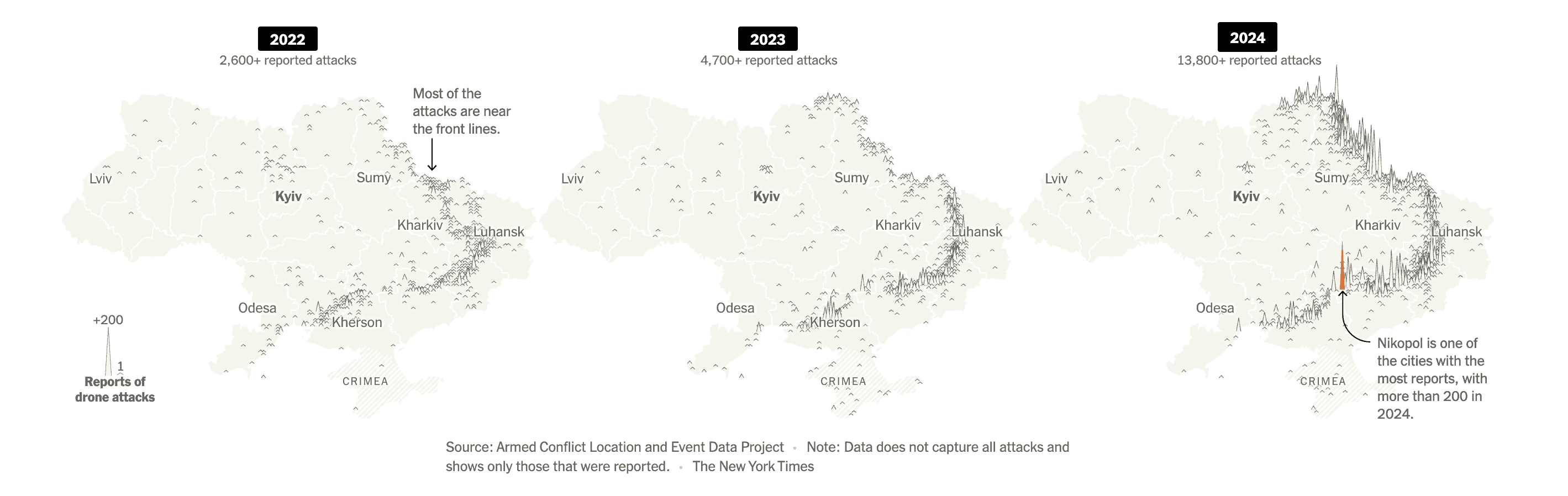
Then jammers came in to tackle down wireless drones from the skies, so pilots started to use miles and miles of optic fiber directly connected to the drones so they can keep control of them and get over the jammers… And there is where things get wild once more for big targets like tanks and vehicles in general.
I was involved in other projects, and the time went on, but the idea came back after a conversation with one of our correspondents who has been to the Ukrainian battlefields many times. Thomas (TM) has a lot of experience when talking about guns and war in general. He was a Marine himself. TM continued to think about the various types of tanks and vehicles in Ukraine, and with his expertise on the subject, it was easy to convince me to take a closer look. I did some cursory research and found a wealth of material.
The hunt for turtle tanks (Aug. 2025)
In my regular process, I start with a text document where I add links, notes on elements relevant to the story, visual references, names and emails of potential experts to interview, references to similar articles, and in some cases, some draft paragraphs that could later help define the structure of the story. Then I add everything to a drive folder to keep the reporting doc alongside PDFs, videos, photos, and any other material I might need later. I keep everything I find forever… or maybe until something extraordinary happens.
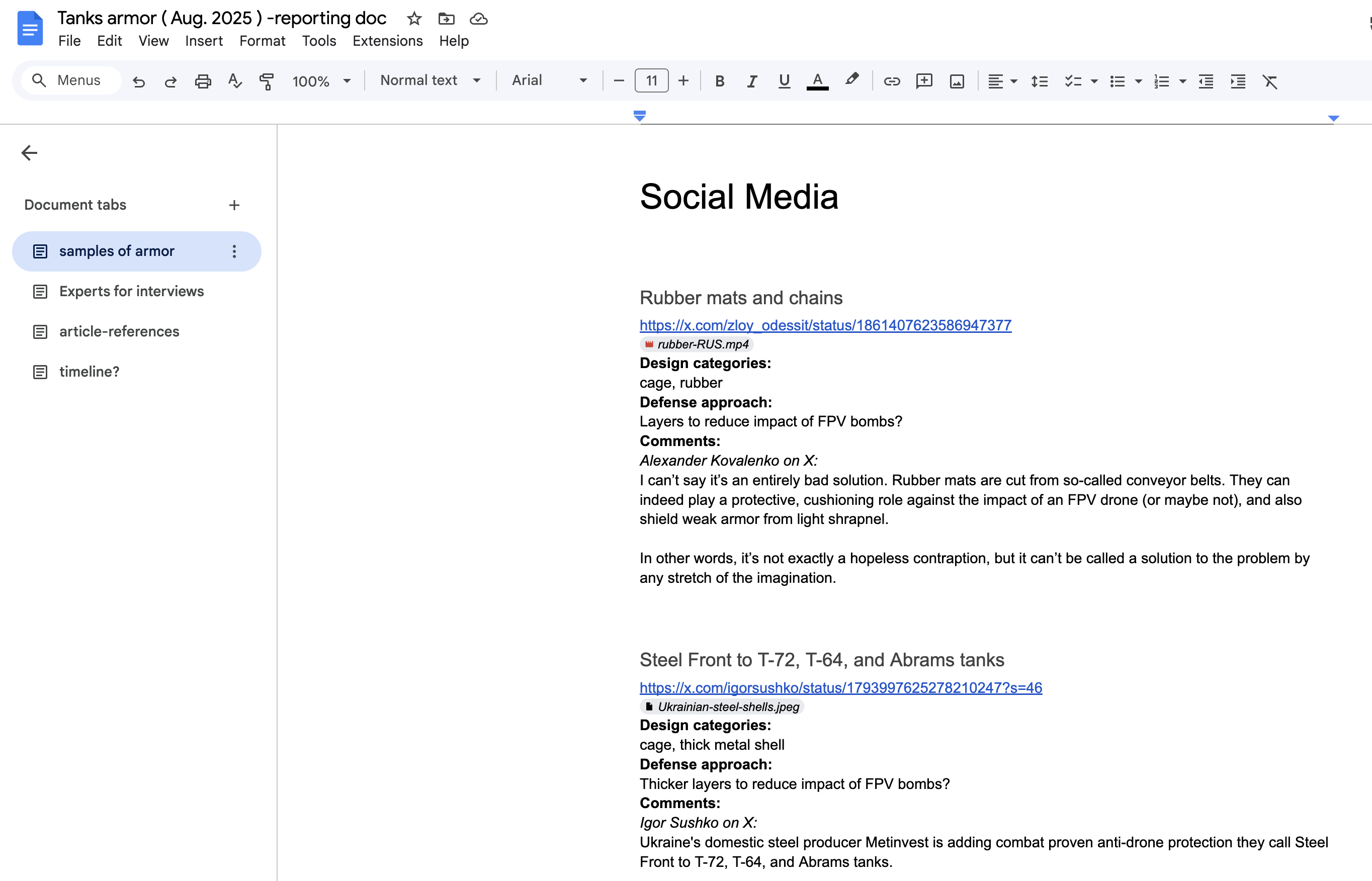
Visual references are very important. Social media like X and Telegram are good ways to improve the understanding of the structures. I often keep every link with a little context of what it is about, the original link, and some sort of initial categorization that might help to group things later. As a visual storyteller, I think it’s important to explore themes for your sections. Perhaps things can be grouped by common characteristics, chronology, aspect, or function. That kind of grouping, if possible, helps give a sense of harmony to the story.
Perhaps the only downside to social media material is that it takes time to verify it. You must navigate through many precautions, including copyright, veracity, the tone and source in which it was shared, among others. I spent about 2 days chasing links and references this way. Below is a mix of some of the references (both social and wire-sourced) I used for the drawings and the article itself. At the end, I discarded about 80 images and videos from social media for diverse reasons.
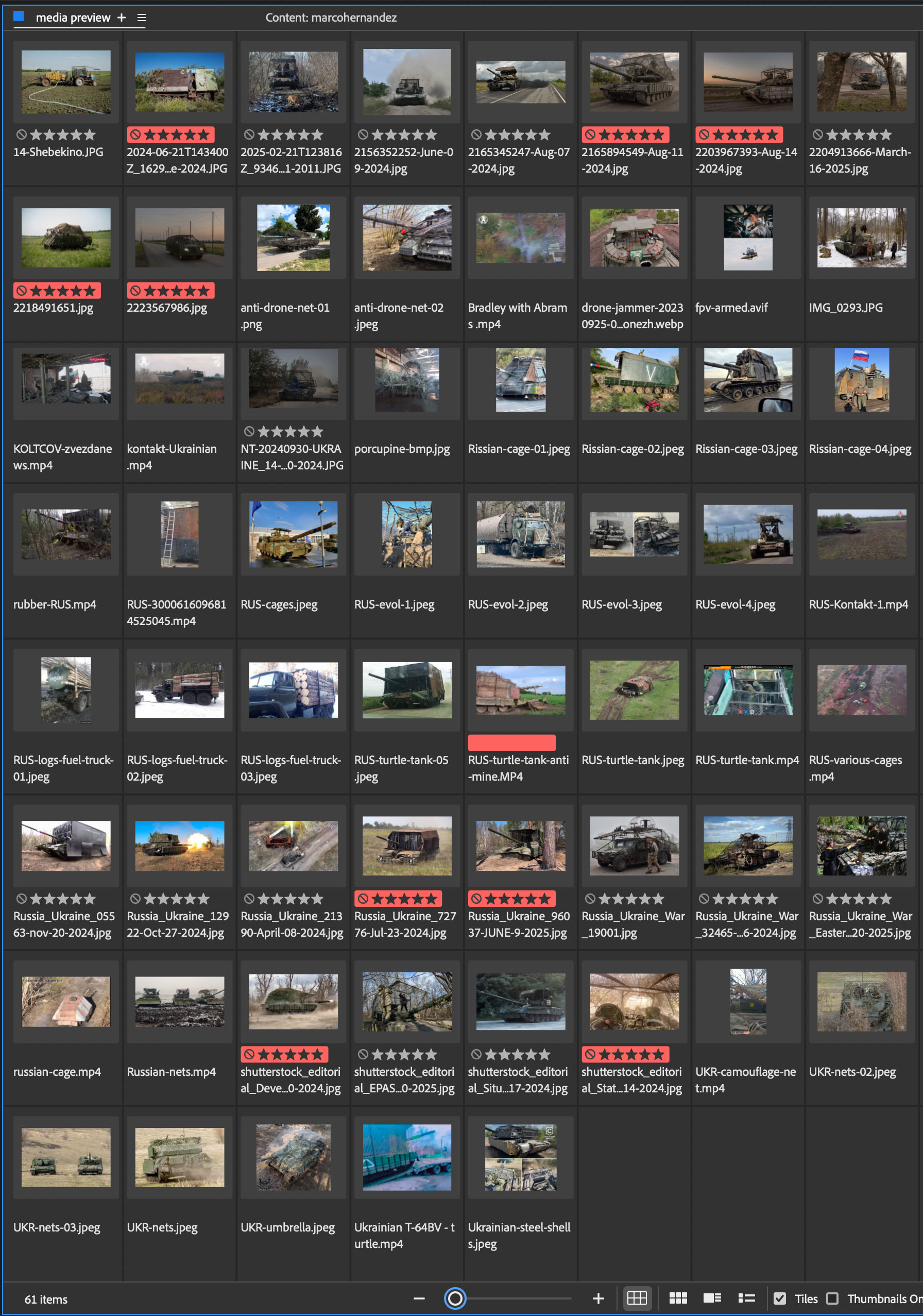
Luckily for me, our correspondents and news agencies have extensively documented the turtle tanks, and I only spent a few hours searching the archives for verified images from photographers I could use in the story. Way easier, but I think it’s always necessary to check as many places as possible before actually starting the production.
Drafts for a new story
Once the research phase was over, I dedicated myself to making a very basic structure with some doodles for some visual moments in the piece and writing some paragraphs to guide the narrative.
Projects at the New York Times require a google document where we drop text and parameters for components, it’s mostly Svelte and Archie Markup Language (AML). The tanks project looks like the image below from the main driving document and its wired to a package of local code files with a back-up in Github.

We use the same document to write the text and manage the components, including the visuals and any other features or functionality we add to the page. My role often includes creating a draft with the basic ideas written down to serve as a guide if I’m collaborating with someone else, as in this case. Of course, as you can see here, my expertise is not writing, but it helps to wrap up the ideas to engage better with the story. Sometimes, I do the whole piece on my own, including the words (my apologies to the copy editors who might have headaches with my text). However in this case, TM would be the one writing the final copy, so I didn’t want to interfere too much with the text anyway.
Hands on doodles!
About a week later the next stage began, up to this point I hadn’t even seriously touched my Wacom to start sketching. But it’s impossible to start that without doing research, adding a structure, and connecting some web components first.
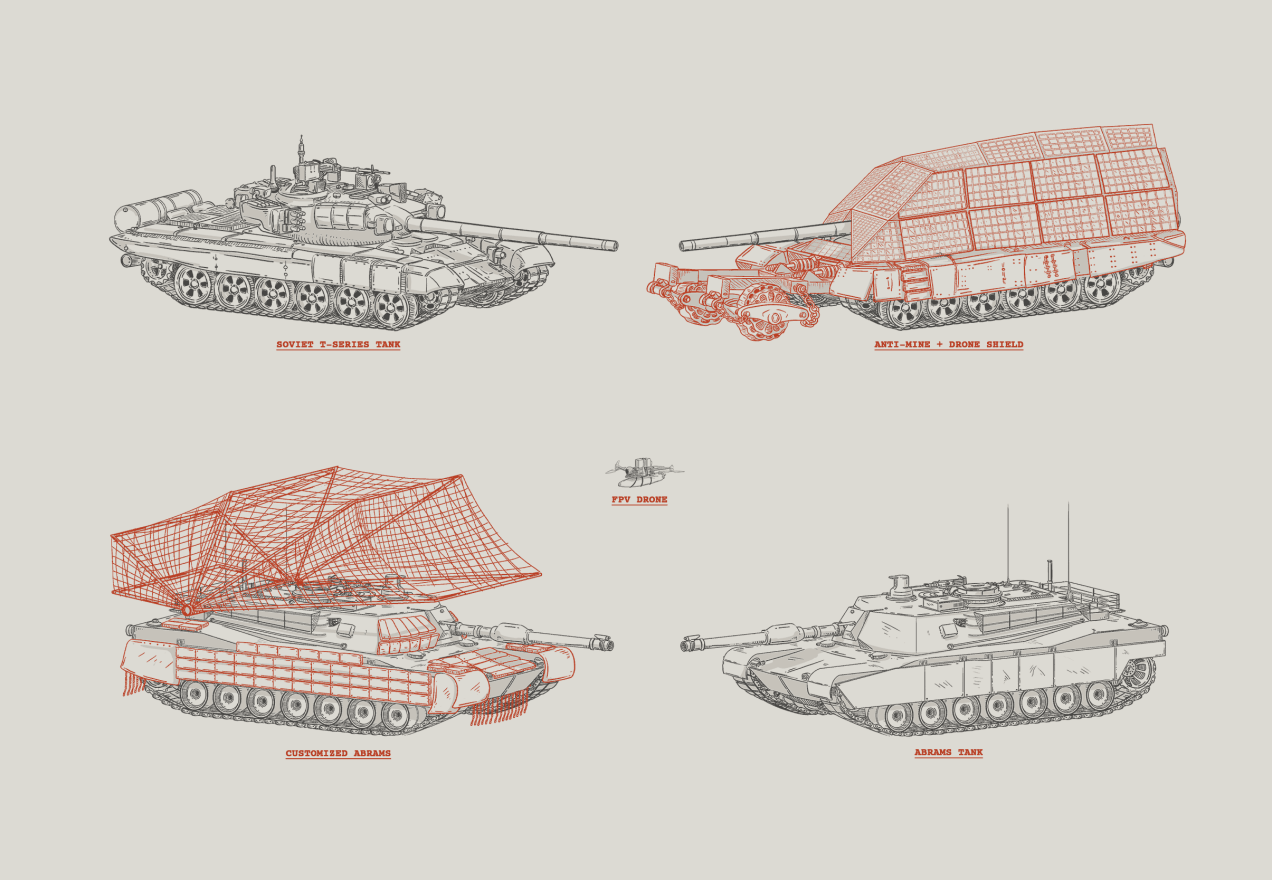
I defined the tank models I would need based on the references, documents, and stories I found during my previous process. I needed at least one Soviet T-series tank and an Abrams to reflect what had happened on both sides of the battle. Even with the intention of making the piece interpretive, the first step for me was to make some rough doodles, then model some guidelines for the illustrations using Cinema 4D, then returns to photoshop and finally to illustrator for labels and other stuff.
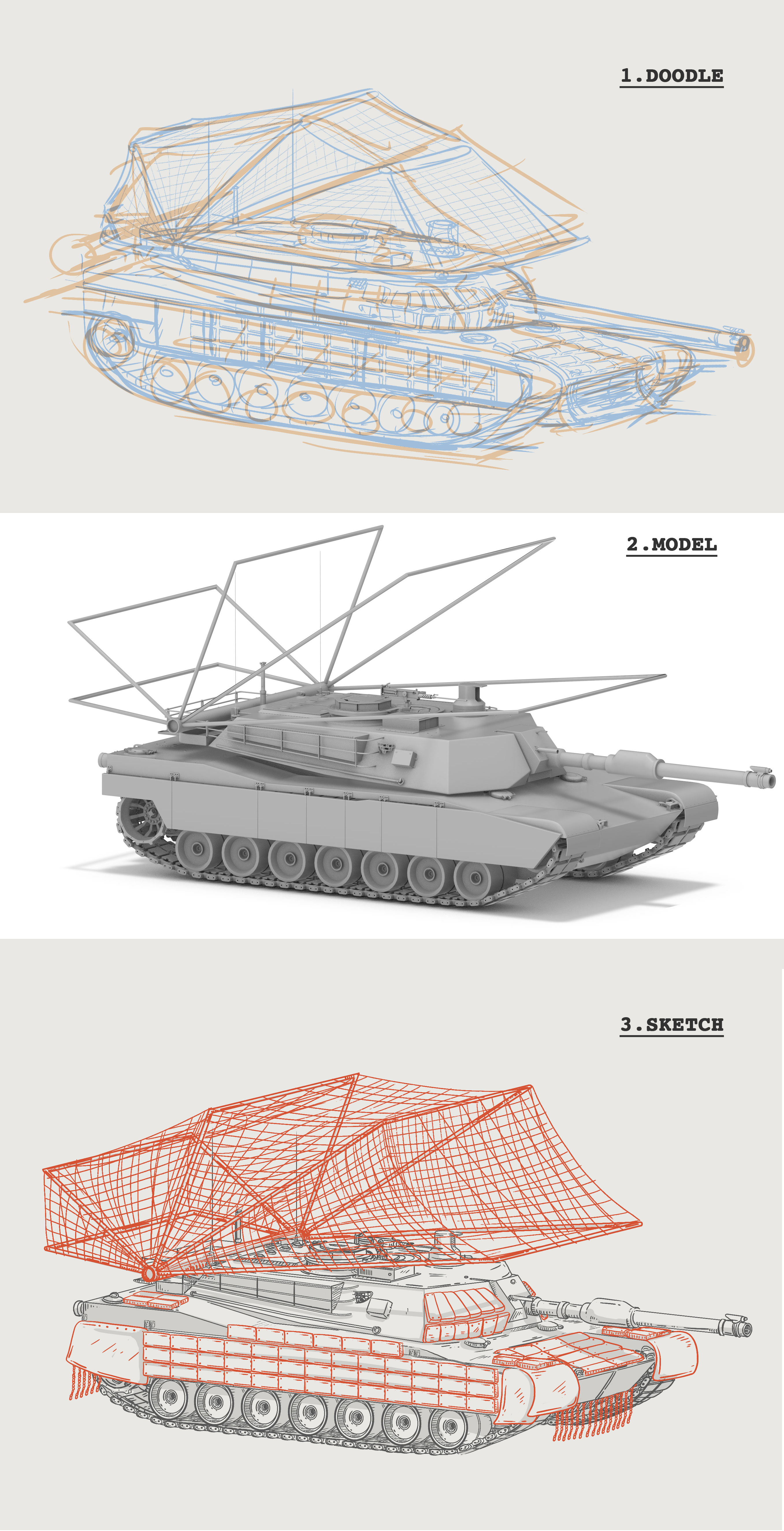
I didn’t model all the structures, just basic guides to maintain proportions. Here you can see how I did some basic geometry to guide myself later in photoshop on the free hand-drawing.
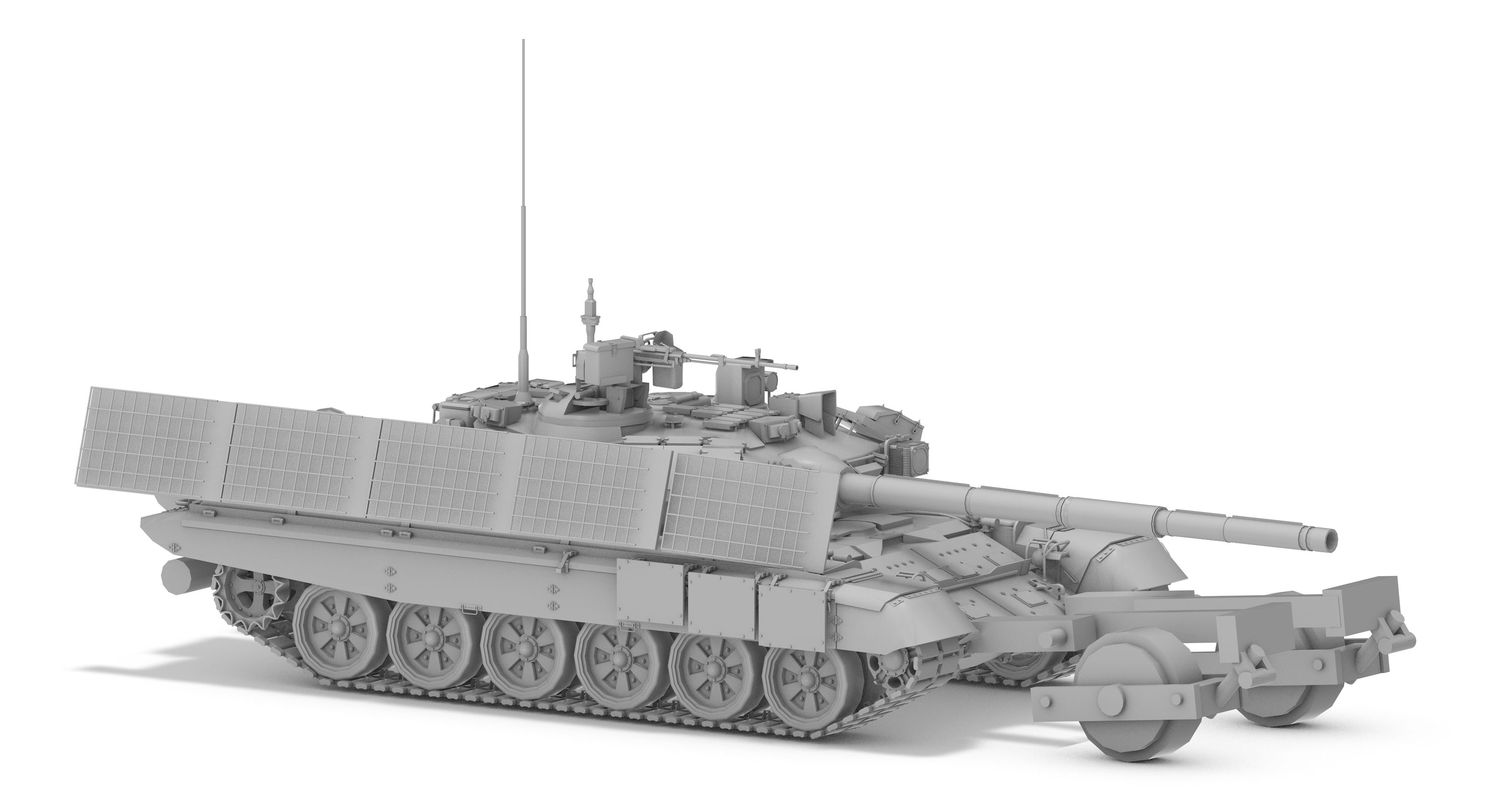
Then, with the images I collected, I gradually drew the improvisations the soldiers had made on the corresponding tanks. The final versions were sketched in Photoshop, 3 times the size of the publication to gain some detail in the final result.
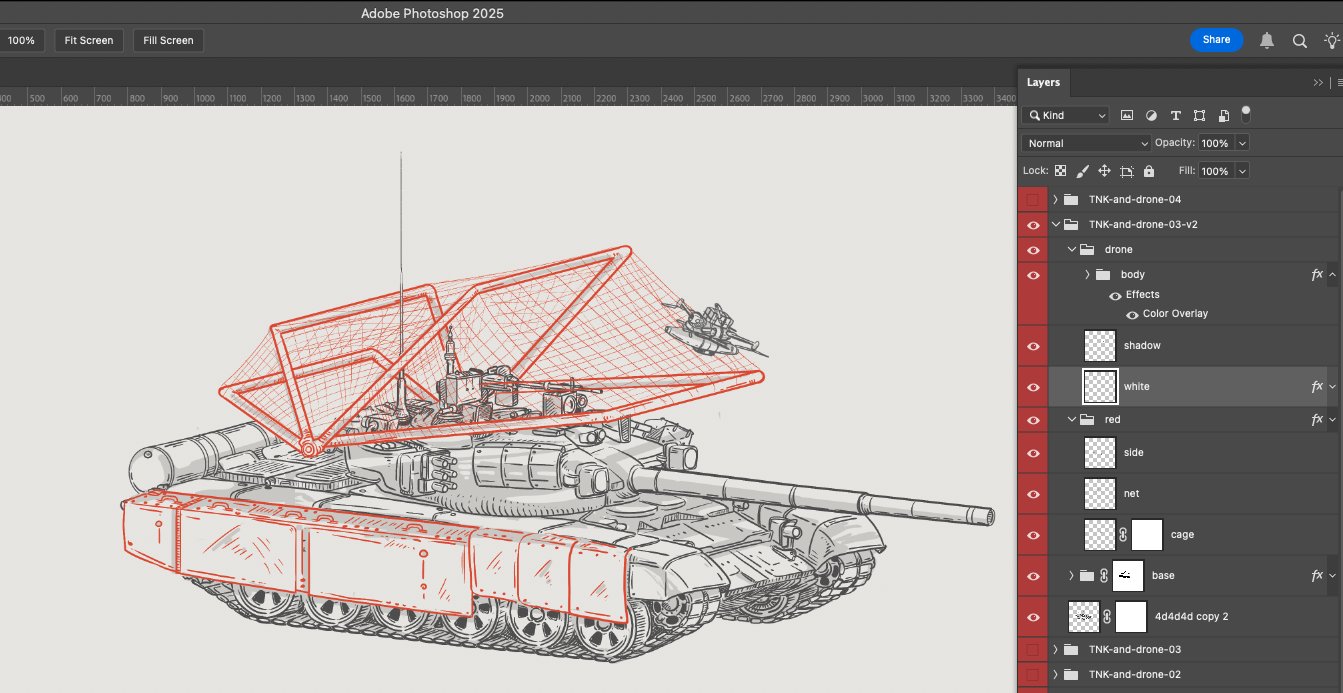
Finally one more step to add labels and play around with the layout and text blocks if required. Below an early version of one of the graphics.
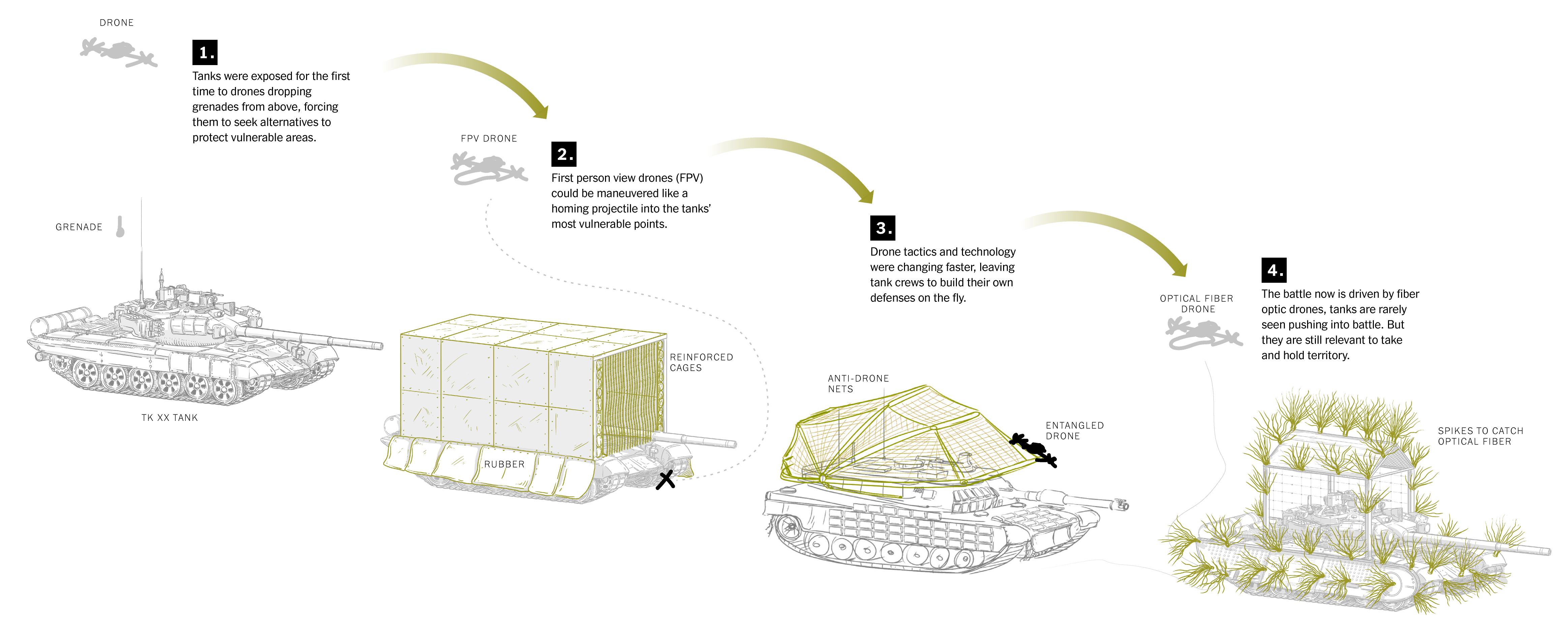
This was going to be an illustrated piece; I was clear about that from the start of the conversation. Illustrations, in general, help unify a piece visually. While it’s true that not every story can be solved with drawings, sometimes the abstraction of doodles and even their imperfections provide the reader with a bit of room for interpretation.
However, it’s good to accompany these types of pieces with some photos to show the real evidence. After all, it’s not that I’m imagining these vehicles; each one must come from reality. That ethic still distances us from artificial intelligence, even if only temporarily.
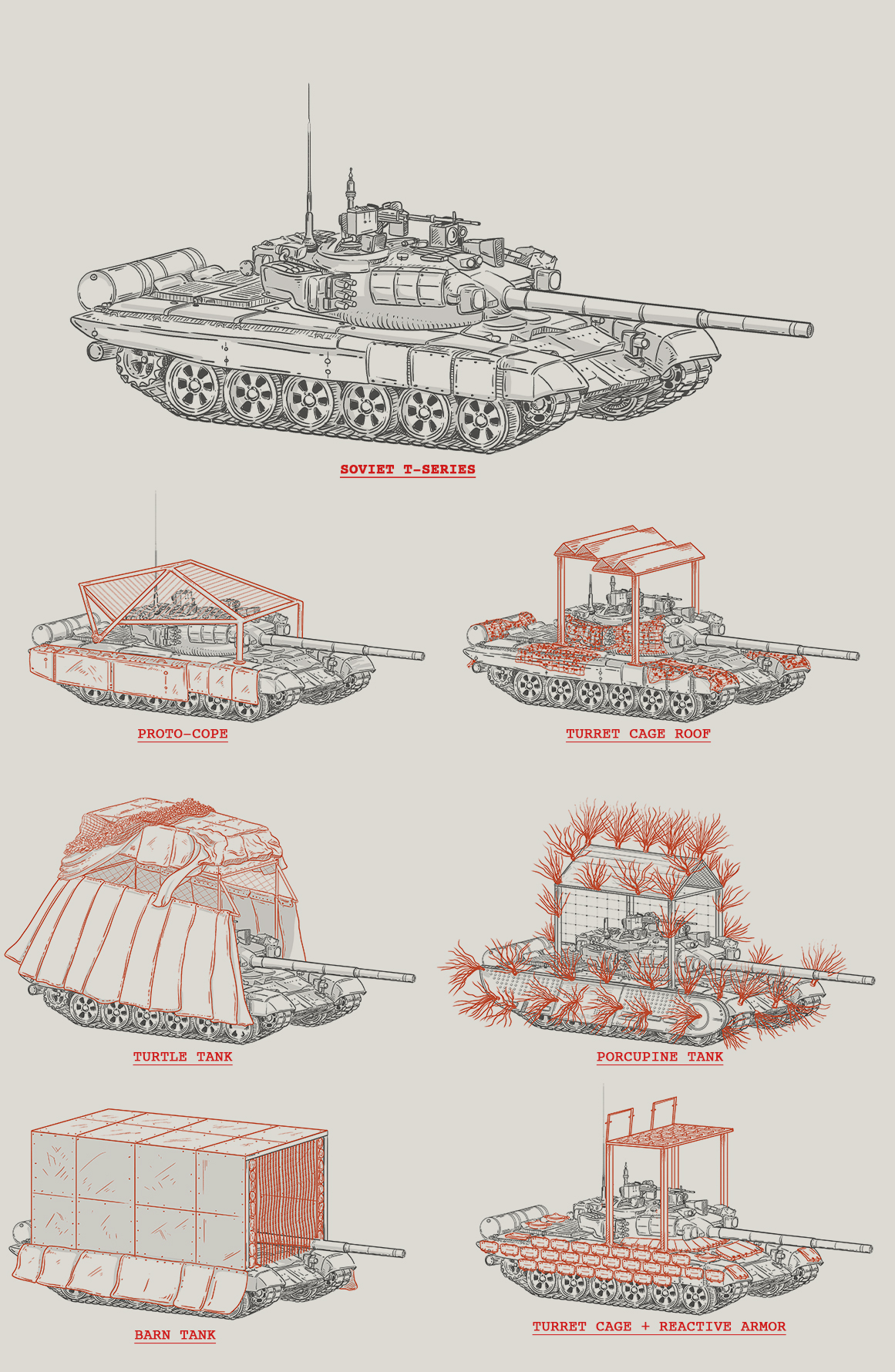
If you look back to the top of this article and find SQ. reference #1 you will see the the diagram we did not used in the February story, in the most recent piece I turned that into a scrolly explaining how the modifications transformed the T-Series tank into a troop-transport vehicle.
Because of the way our team works, once the pieces are published online, I have to move on to the next project. Part of the graphics team at the Times is dedicated exclusively to graphics for the print version.
That means I have to prepare pieces for one of my colleagues in that group, along with another editor. The text is repurposed so it makes sense on paper. Occasionally, I have to produce additional asset at a different resolution or with particular specifications, like when I use animation, but often I’m already working on another project, as was the case with this one.
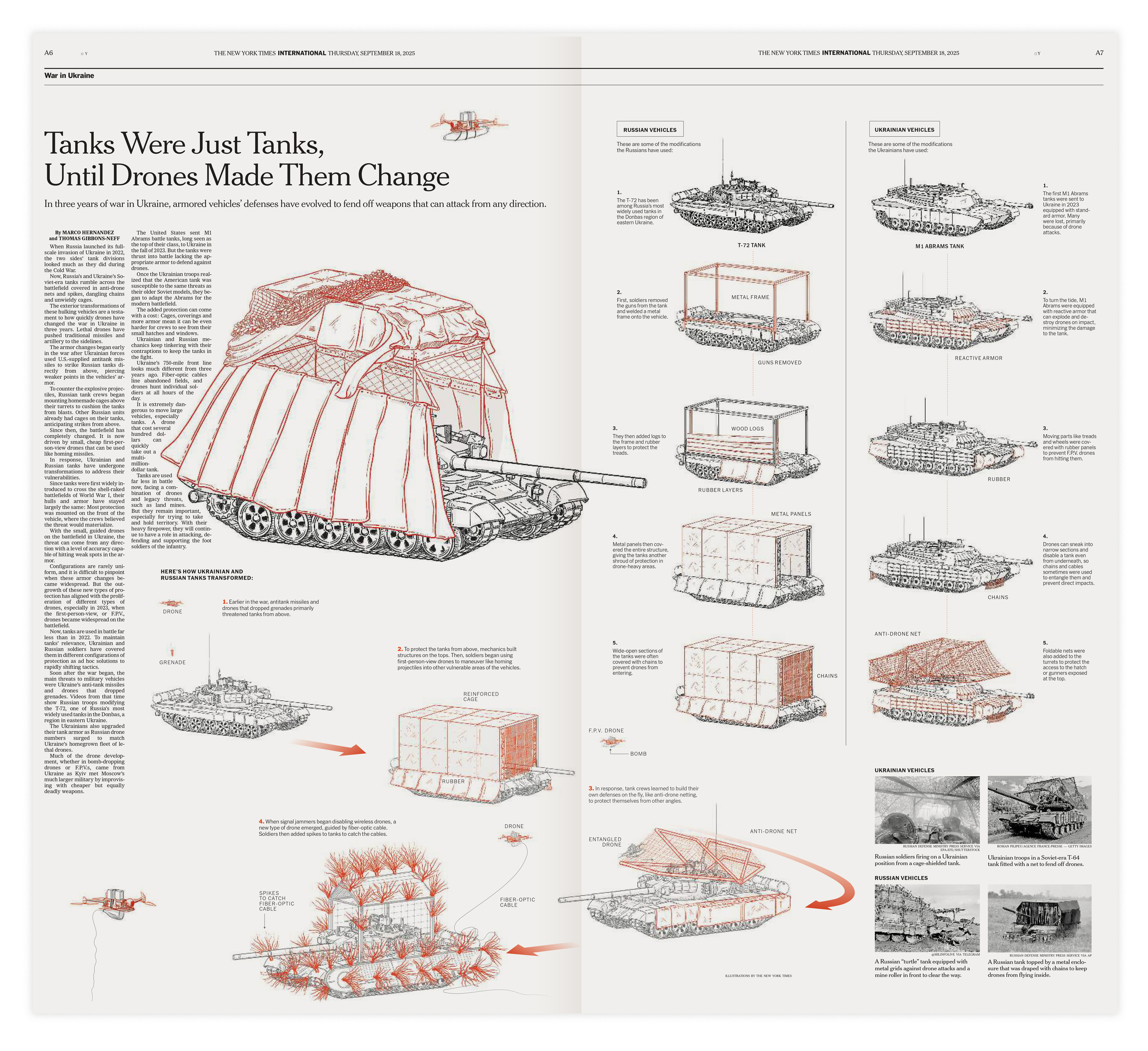
The print version was published today in the US, you can take a look to the double page and a little detail in the front page if you have access to the paper.
Thanks for reading, and see you next time!
Note:
–Although the images in this post are part of my production process, they are property of the New York Times.–
 Marco Hernandez
Pingback: 2025: the year in graphics | Marco Hernandez